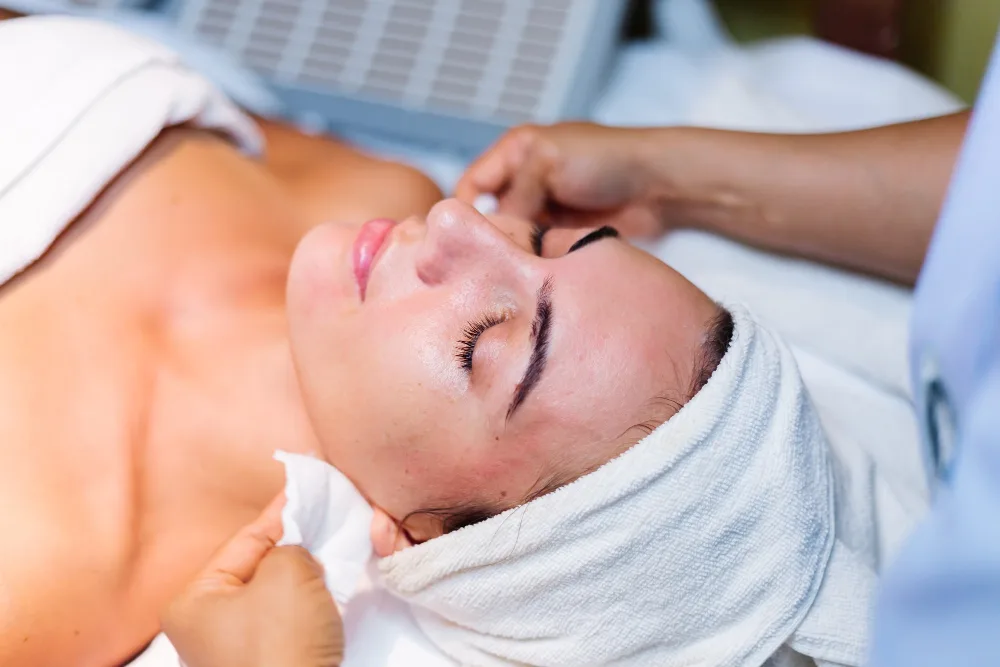
A lot of people who come in asking about acne scars are actually dealing with something else: marks left behind after the acne has healed. They have marks, flat discolouration left behind after a pimple heals, either a brownish patch or a lingering red or purple spot. True scarring changes the texture of the skin – a dent, a raised bump, something you can feel with a fingertip in the dark. Marks are flat. Knowing which one you’re dealing with makes choosing the right treatment much easier, especially before booking a post-acne facial treatment in Las Vegas.
What’s actually happening under the mark
Brown or tan marks are usually called hyperpigmentation or PIH. I see these marks appear when acne inflammation pushes the skin to produce melanin. Red or purple marks are called erythema or PIE, and they happen when tiny blood vessels near the skin surface get damaged, not because of extra pigment. Both PIH and PIE fade over time. The fading can be very slow. PIH may stay for months and sometimes even longer. PIE tends to clear, yet the word “eventually” does not help anyone who looks at their face each morning. That is why treatments are used to speed up the fading process.
The unglamorous answer that matters most
Sunscreen does more for fading these marks than any facial or serum, and it is the part that people skip.
UV exposure directly makes PIH worse, feeding the melanin production that created the mark in the first place.
If you are treating marks but regularly exposing your skin to UV without protection, you are working against the treatment.
Daily broad-spectrum SPF may sound basic. It is an important part of keeping those marks from becoming darker and helping treatment stay on track.
What helps beyond sunscreen
Beyond sunscreen, ingredients like azelaic acid, niacinamide, vitamin C and retinoids are often used to help out skin tone and give the skin a clearer appearance. Chemical peels that use glycollic acid, lactic acid or salicylic acid can speed up the skin’s natural exfoliation process. This helps the skin shed cells more quickly than it would on its own. A good post-acne facial usually brings together several of these methods in one treatment—exfoliation, soothing ingredients to calm any active inflammation and something that targets the pigment directly. In reality it’s often the mix of these steps that makes the difference,, not just one single ingredient doing all the work.
Red marks are a bit different because the problem isn’t just pigment. Post-inflammatory erythema, or PIE, involves changes in the blood vessels close to the skin’s surface. Because of that, a treatment plan that only focuses on pigmentation may not be enough. For redness a dermatologist might suggest a vascular laser treatment to target the blood vessels and reduce the redness.
A caution worth taking seriously
Anyone with medium to deep skin tones should be careful with aggressive resurfacing treatments and certain laser types, since overly intense treatment can trigger the skin to produce more pigment in response to the treatment itself, worsening the exact problem it was meant to fix. That doesn’t mean professional treatment is off the table. It means the treatment should be chosen with your skin tone and history in mind rather than using the same approach for everyone.
What a realistic timeline looks like
These marks usually improve gradually, so it’s better to think in terms of weeks and months rather than expecting a change after one appointment. How quickly the marks fade varies considerably. Some improve within a few months, while older or more stubborn pigmentation can take longer. One facial isn’t likely to erase a mark that’s been present for a long time. Fading usually takes repeated treatment and consistent skincare at home.
When it’s not just marks
If part of what’s bothering you is actual texture, pitted scarring, raised areas, or skin that looks uneven to the touch in a mirror as much as in a photo, that’s a different problem than PIH or PIE, and it generally needs a different approach: microneedling, subcision, or laser resurfacing aimed at texture instead of colour. The first step is figuring out whether you’re dealing with a colour change or an actual texture change, because the treatment options are different.
Soft Touch Studio Medspa’s post-acne facial is built around the marks-and-redness side of this problem specifically. If you’re not sure whether what you’re seeing is discolouration or true scarring, if you’re unsure which one you have, a consultation can help determine whether you’re dealing with pigmentation, redness, or actual scarring before treatment starts.