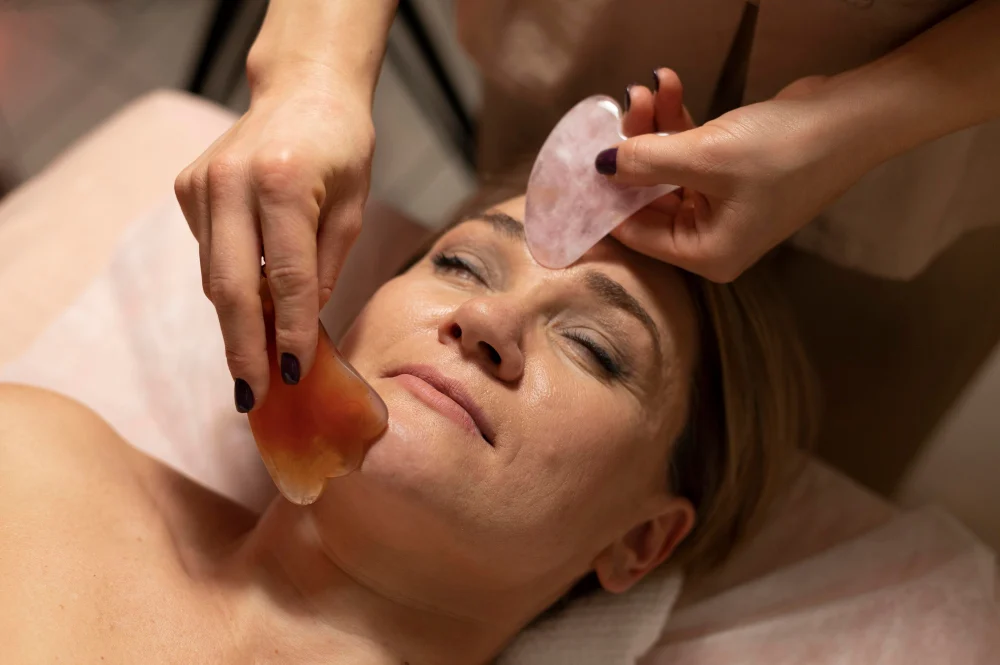
A stone scraped across a jawline doesn’t reshape bone. Nothing about a facial massage moves fat or tightens skin the way a surgical lift does, and any treatment implying otherwise is overselling what these techniques actually do. What you can realistically expect is much simpler: less facial tension, less puffiness, and a slightly more defined look for a while after the treatment.
What’s actually happening under the skin
Fascia is the connective tissue that envelops and supports muscles and other tissues in the face. Some areas around the jaw may also be tight, especially for those who tend to hold their teeth and keep them clenched. Myofascial release involves gently applying pressure to the tissue to release tightness and allow the muscle that is underneath to move more freely. The trick is that there isn’t much research focusing on facial sculpting with myofascial release. Not as much research has been done on its effectiveness, specifically when it comes to cosmetic facial changes.
Gua Sha acts on a similar principle, but by a different mechanism: A smooth-edged tool is used to drag the skin with controlled pressure, resulting in what researchers call “transient mechanical stress”. That is one reason that it may seem a bit less swollen after a workout. That change is another story for the long term, and there’s far less evidence there. In a small study of 2025 participants, facial measurements were found to change after 8 weeks of consistent use of gua sha. That’s intriguing, but it was a small study, and it doesn’t necessarily mean you’ll have a permanent facelift after using gua sha. It was an observable, not spectacular, outcome.
Buccal massage is performed both inside and outside the mouth; also, the practitioner can massage around the cheeks and jaw muscles from both sides. In terms of formal research, it’s a newer method—most of the research that backs it up is anecdotal and based on clinical experience with jaw tension and TMJ discomfort, not on clinical trials of the face. As yet, there is not a lot of good research on buccal massage, and so, I would hesitate to say that it can do all the things other better-studied methods of myofascial massage can do.
Why “sculpt and lift” doesn’t mean permanent
Whatever change you see from these techniques isn’t going to behave like a surgical facelift. It’s something you maintain rather than something permanent. The effect can fade as the initial reduction in tension and puffiness wears off, which is why people who like the result often repeat the treatment. That’s the honest trade-off: real, noticeable results that build with consistency, not a one-time procedure with a permanent outcome.
Who tends to notice the biggest difference
But if you have a lot of tension or puffiness around your jaw, you’ll likely notice more of a difference than if you don’t have much tension around your face. If you have little facial tension to start with, you’re going to see a temporary glow and de-puffing, which is great, but not as noticeable as a dramatic contour change, so you may want to set your expectations accordingly.
What to ask before booking
If you’re looking for a more lifted or sculpted appearance, make sure to enquire about what can and cannot be achieved before booking. Additionally, it is important to know how many sessions are typically required, how long any changes in appearance are likely to last, and if they offer other therapies like LED therapy or lymphatic drainage. At Soft Touch Studio Medspa in Las Vegas, you can find facial treatments that revolve around these techniques. Being honest, the answer for anyone who is curious is a straightforward discussion about what your face may be tight, puffy and locked up on, and then, what a realistic number of sessions can achieve from there is not what one session, or some number of sessions, can achieve.